
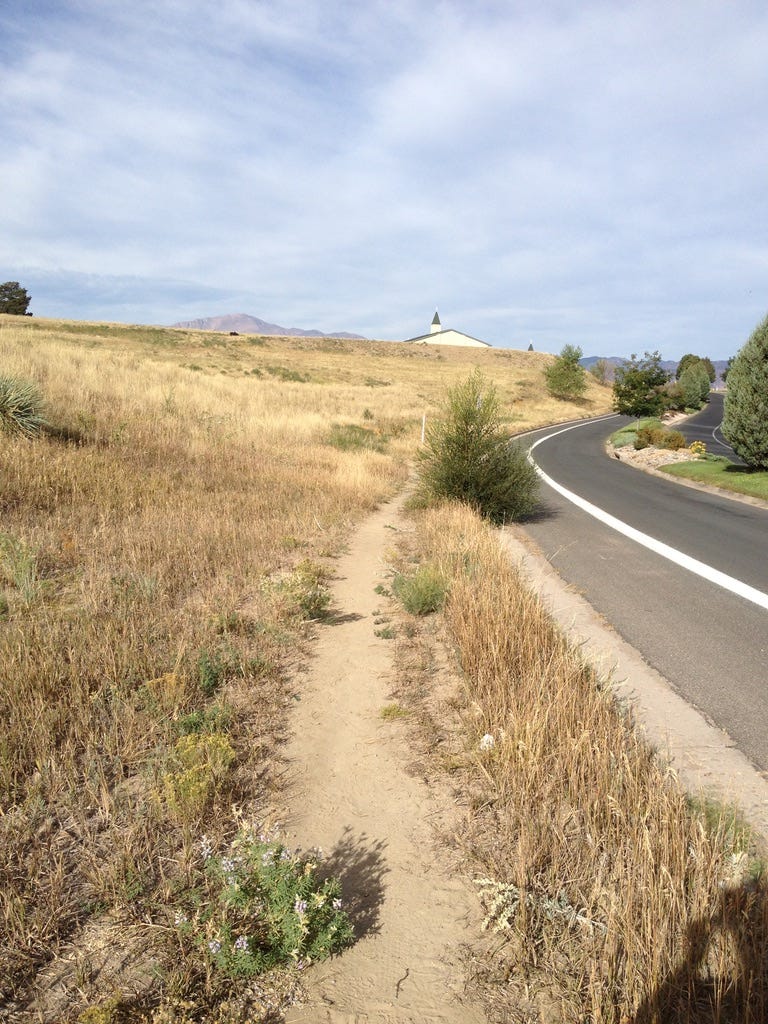
Some years ago, I yearned (‘pined’ might be a more accurate word; it was an experience of pain-filled passion) to have two lives. At the same time.
It is horribly lovely (by which I mean that it is horrible, and it is lovely) to report that after a lot of work and planning and some luck and some magic, I actually got what I wished for.
I live in Newfoundland and in Vermont. I am a minister and a geographer. I am a guild-tied trained professional and a scholar. I am a devoted mom and a happily partnered spouse and also I live a life alone, sometimes very alone, going to bed on my own and making meals only for myself and inhabiting a space full of things that only I have touched.
It's a dream, all of this.
And in the proverbial way of wished-for things, the blessings are tight-woven with some real curses.
Sometimes across these seasons I wake up and for a disorienting second, I don’t know where I am.
This brings a quick thrill of panic. Then comes a sinking feeling and some questions. Such as, is this how the Quantum Leap guy would feel? And also, is it possible that I should quit this bonkers shit.
Over this past year I’ve been in seven countries, seven provinces, and more states than I’m willing to count. My travel schedule is far from the busiest- I know several people who for various professional and personal reasons are constantly on the road, living itinerantly. But I, myself, am not itinerant- that word doesn’t fit my attachments or my relationships or my hopes.
I am, instead, a place-rooted sort of person.
I hope to shed light, in fact, on what place-rooted ways of seeing and valuing community and connections might look like.
And yet one deep and vulnerable truth of my life is summed up in two words, which are “I left.”
I sit ambivalently with that sentence.
It holds entire worlds within it, places of private pain (being called to ministry far from everything my family and I knew and loved) and public abandonment (the designation of Wyoming, my home state, as essentially a resource extraction zone to benefit the families of out of state investors; this came at the expense of generations of Wyoming kids who were pushed to leave for lack of jobs or discernible future on the land where we were raised).
How might I honor the truth and the agency of individual leave-taking while also being real about social forces and economic pressure and the continual institutional privileging of some places above others?
How can we be real, in short, about the threads of fierce self-determination and also multivalent helplessness that play out in every human story?
A fact: there are places- in geography, in relationship, in caring, in belief- that each of us have left. There are landscapes upon which we have turned our backs, or which we have been forced to relinquish, or which have ceased to exist except in memory.
And it is true also that between here and our last breath, between “here” and wherever “there” turns out to be, we each have more leaving to do.
I am beginning to understand that it’s only through this reckoning with leaving, and with the complex and sometimes contradictory recognitions that next happen, that I might touch what it means to stay.
What does it mean in the US and Canada in 2025 to be place-rooted?
What does it mean for and within a faith community, for a people to find their roots?
What do place and rootedness mean in my own life?
These will, I expect, be among my deepest daily questions.
Having already replied to this on Mastodon, I won’t repeat it. But the idea and visceral feeling of a home place (or places) is so real. Even for those of us who are — as I am — large, noisy potted plants that aren't sure what “home” means. (Seven states, three of them twice, one of them thrice, and two nations on other continents have been home at various times, and in almost all of them I’ve moved at least once within them while there. “Where are you from?” is a question that always gets a deep breath from me before I ask if they just want to know where I was born, or where I moved here from, because the fuller answer will take five minutes.)
And I know that several of the homes I lived in no longer even exist.
Such a real and important topic.
I think I may be the human analog of an air plant, maybe.
Hi Jordinn--I think you might find this article on public benches interesting. I was going to share it and tag you on Facebook, but couldn't find you there to tag, so here it is? https://placesjournal.org/article/the-disappearance-of-the-public-bench/
warmly,
Marcia